
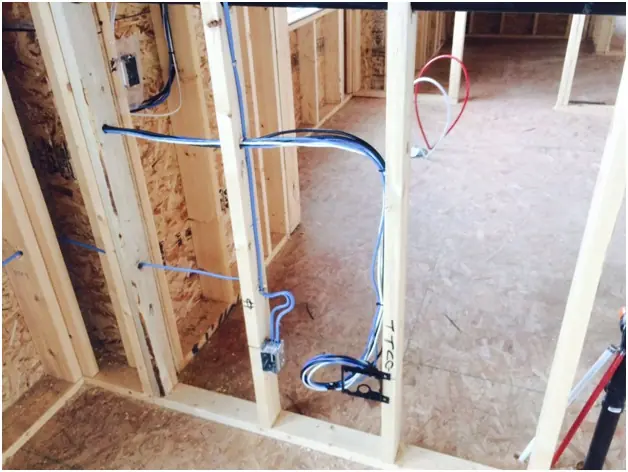
New construction low-voltage prewire and structured cabling in a Cherry Creek Denver custom home

New Construction

Prewire it once. Do it right.

The single best time to plan a smart home is before drywall goes up. We partner with builders, architects, and homeowners for new construction prewire in Denver, low-voltage prewire, and structured cabling that future-proofs the home.

New construction low-voltage prewire and structured cabling in a Cherry Creek Denver custom home

What's included with new construction

  • On-site walkthroughs with your builder, architect, and electrician
  • Structured cabling: Cat6/6A, fiber, speaker wire, coax, control runs
  • Home theater, media room, and whole-home audio rough-in
  • Camera, access control, and security device pre-runs
  • Lighting control, motorized shade, and HVAC sensor wiring
  • Conduit pulls and back boxes for future-proof flexibility
  • Detailed labeling, documentation, and as-built drawings

Builder-friendly

Clean trade coordination with framers, electricians, and HVAC — on schedule and on spec.

Future-proof by design

Extra conduit and home-runs so tomorrow's tech installs without opening walls.

Documented end-to-end

Every cable labeled and drawn — your home's nervous system, fully mapped.

Getting prewire right during the framing window

Prewire happens during a narrow window in the construction schedule — after framing and rough mechanicals, but before insulation and drywall close everything up — and it's the cheapest point in a home's life to add low-voltage infrastructure. We work directly with builders across Castle Rock, Parker, and Highlands Ranch's new-construction communities, coordinating with the electrician and HVAC contractor so our runs don't conflict with theirs and everyone stays on the framer's schedule. Missing this window means every future speaker, camera, or network drop has to be fished through finished walls instead of run openly through open stud bays.

We design the prewire around the home's actual floor plan and how the builder or homeowner expects rooms to be used — not a generic checklist — placing home runs for every TV location, speaker zone, access point, camera, and control keypad back to a central low-voltage panel location, even if some of that equipment won't be installed until months or years after move-in.

Conduit, home runs, and designing for what comes next

The biggest value in a good prewire isn't just the cable that gets pulled — it's the conduit and empty back boxes that let a homeowner add capability later without opening a single wall. We run extra conduit between the low-voltage panel and key locations like an exterior wall (for future landscape audio or cameras), a media room, and a home office, so a system upgrade five years down the road becomes a matter of pulling new cable through existing conduit rather than a retrofit project.

This forward planning matters most in homes where the buyer knows they'll add a home theater, whole-home audio, or a security system later but isn't ready to commit to the full scope during construction. A well-planned prewire costs a modest amount extra during framing and can save thousands in retrofit labor and drywall patching later.

Documentation, trade coordination, and quality control

Every cable we run gets labeled at both ends and logged against an as-built drawing of the home, so years later — whether it's us or another technician — anyone can identify exactly what a given cable does and where it terminates without opening walls to trace it. This documentation matters most in larger new builds across Denver's luxury communities, where dozens or hundreds of individual cable runs are otherwise indistinguishable once insulation and drywall go up.

Because prewire happens on someone else's construction schedule, coordination is as much a part of the job as the wiring itself. We attend framing walk-throughs, flag conflicts with HVAC ducting or plumbing before they become a problem, and inspect our own work before drywall closes it in — a scheduling discipline that keeps the builder's timeline intact while making sure nothing gets buried incorrectly or forgotten.

Frequently asked questions

How much does a new-construction AV prewire cost in Denver?
Prewire for a typical Denver custom home runs $6,000–$25,000 depending on square footage and how many zones, cameras, keypads, and TV locations are planned. It is by far the cheapest phase to be generous in — cable is inexpensive while walls are open.
When should the low-voltage prewire happen?
After rough framing, plumbing, and HVAC, and before insulation and drywall. We coordinate directly with your builder's schedule and walk the house with you at framing to mark every location.
What should I prewire even if I'm not installing the equipment yet?
At minimum: Cat6 to every TV and access-point location, speaker wire to main living spaces and the patio, conduit to the theater and rack, camera runs at each corner and door, and keypad and shade power at the windows you'll eventually automate. Capped, labeled, and documented for later.
Do you work directly with builders and architects?
Constantly. We provide low-voltage plans, coordinate with electricians and framers on site, and hand over as-built documentation at completion.
What if I skipped the prewire?
We retrofit finished homes all the time — fishing cable through existing walls and ceilings with minimal, patchable access. It costs more than prewire, but very little is truly impossible.

Background reading before you spec the system, plus the Denver suburbs where we install it most.

Guides worth reading first

Works well with

Where we install this

Get a free new construction consultation in Denver.

Free in-home consultations across the Denver Metro Area.

Book a Free Consultation